


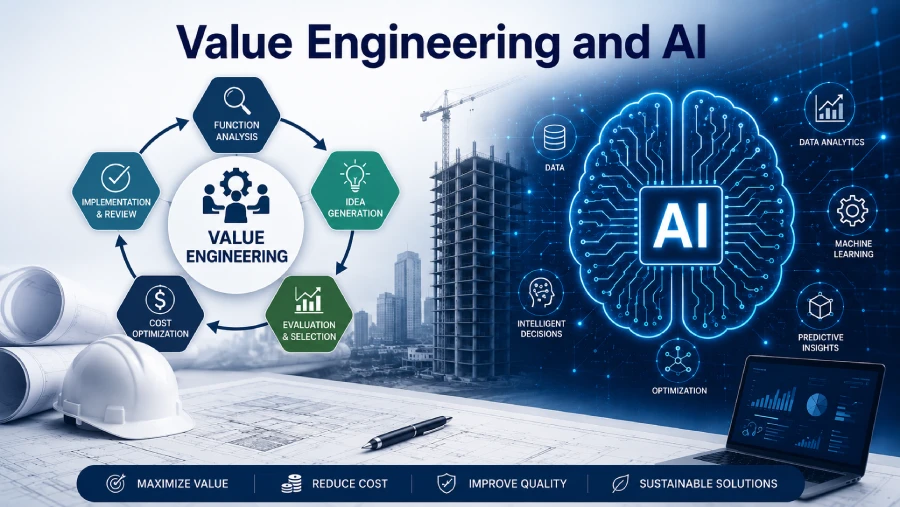
Value Engineering in the Era of AI and Emerging Technologies
Artificial Intelligence (AI), automation, digital twins, the Internet of Things (IoT), robotics, blockchain, and other emerging technologies are transforming the way organizations operate. Businesses today have access to powerful tools that can improve efficiency, automate tasks, and generate insights at unprecedented speed.
However, technology alone does not guarantee success.
Organizations often face important questions:
- Which technology should we adopt?
- Will it solve the right problem?
- Does the benefit justify the investment?
- How can we maximize return on investment?
- Will it create meaningful value for users and stakeholders?
This is where Value Engineering (VE) becomes more relevant than ever.
Technology Does Not Equal Value
Many organizations invest heavily in new technologies only to discover that the solutions are underutilized, overly complex, or fail to deliver expected outcomes.
The challenge is not a lack of technology. The challenge is ensuring that technology creates value.
Value Engineering helps organizations focus on the fundamental question:
What function are we trying to achieve?
Instead of adopting technology for its own sake, VE ensures that every investment is aligned with the desired function, stakeholder needs, and organizational objectives.
Why Value Engineering Matters in the AI Era
The rapid pace of technological innovation creates both opportunities and risks. While AI can automate processes and generate insights, organizations must determine where and how these technologies should be applied.
Value Engineering provides a structured framework for making these decisions.
1. Focus on Outcomes, Not Tools
Organizations often become excited about the latest technology trends. However, the objective is not to implement AI or automation—it is to solve problems and improve outcomes.
VE helps teams define the required functions before selecting technological solutions.
2. Optimize Technology Investments
Emerging technologies often require significant investments in software, infrastructure, training, and change management.
Value Engineering helps identify solutions that deliver the greatest benefit relative to cost, ensuring better utilization of resources.
3. Encourage Innovation and Creativity
VE’s Creative Phase encourages teams to explore multiple alternatives before selecting a solution.
AI can generate hundreds of possibilities, but human creativity and Value Engineering help evaluate which alternatives create the most value.
4. Improve Decision-Making
AI provides data and predictions. Value Engineering provides a framework for evaluating options based on function, performance, cost, risk, and stakeholder needs.
Together, they enable more informed and balanced decisions.
5. Reduce Waste and Complexity
Many digital transformation initiatives fail because they add unnecessary complexity.
Value Engineering challenges assumptions and eliminates non-value-adding activities, ensuring that technology remains purposeful and user-centric.
How AI Can Strengthen Value Engineering
The relationship between AI and VE is not competitive—it is complementary.
AI can enhance Value Engineering by:
- Analyzing large volumes of data quickly
- Identifying patterns and inefficiencies
- Generating alternative ideas and solutions
- Supporting risk analysis and forecasting
- Facilitating collaboration across teams
- Accelerating documentation and reporting
By automating routine analysis, AI allows Value Engineering teams to spend more time on strategic thinking, innovation, and stakeholder engagement.
Emerging Applications of Value Engineering
As technologies evolve, VE can be applied in new areas such as:
- AI implementation projects
- Smart cities and digital infrastructure
- Healthcare technology systems
- Sustainable and green technologies
- Manufacturing automation
- Digital transformation initiatives
- Education technology platforms
- Startups and innovation ecosystems
- Social impact and development programs
In each case, VE helps ensure that technology investments create measurable value for users and organizations.
The Future: Value Engineering + AI
The future belongs to organizations that combine technological capability with value-driven decision-making.
AI can tell us what is possible.
Value Engineering helps us determine what is valuable.
Together, they enable organizations to innovate responsibly, optimize investments, improve performance, and create sustainable outcomes.
Conclusion
Far from becoming obsolete, Value Engineering is becoming increasingly important in the age of AI and emerging technologies. As organizations navigate rapid technological change, they need a methodology that ensures innovation remains purposeful, efficient, and aligned with stakeholder needs.
Technology creates possibilities. Value Engineering ensures those possibilities translate into meaningful value.
In the era of AI, the question is no longer simply, “Can we do it?”
The more important question is, “Does it create value?”